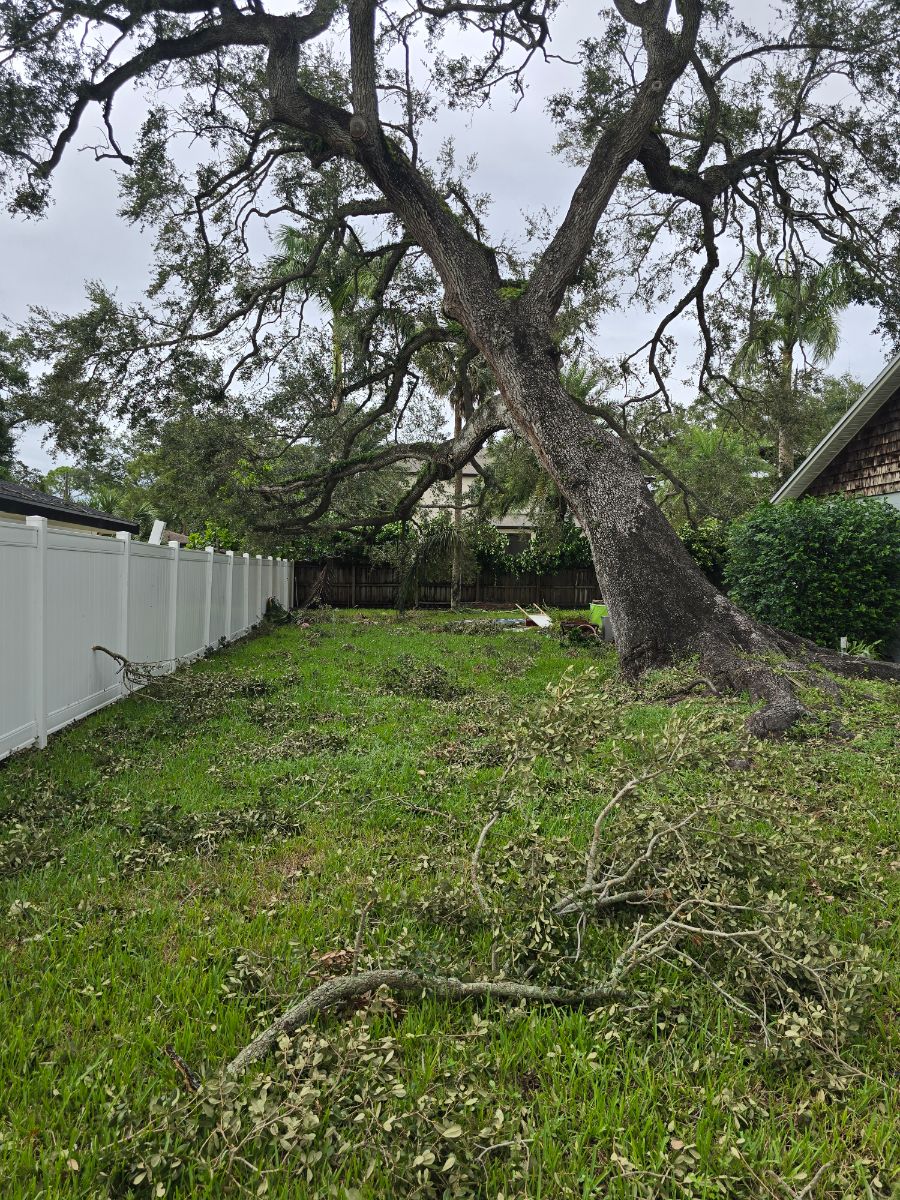
If you've noticed a tree in your yard starting to lean toward your house, you're right to pay attention. A leaning tree is not always an emergency — but it's never something to ignore, especially in Wilmington, where sandy coastal soil gives roots far less grip than most homeowners realize.
Here's how to assess what you're dealing with, when to act fast, and when you have time to plan.
First: Has the Lean Always Been There?
Some trees grow at an angle from the start. A live oak that's been leaning the same direction for 20 years is a very different situation from a loblolly pine that was straight last summer and is now visibly tilted toward your roofline.
A new or worsening lean is the red flag. If you're not sure, take a photo today and compare it to any older photos of your yard. Even Google Street View history can help you see if the angle has changed.
What Causes Trees to Lean
In Wilmington and the Cape Fear region, the most common causes are:
Root damage or rot. Sandy soil doesn't hold roots as firmly as clay-based soil. After years of storms, flooding, or just coastal humidity, roots weaken. A tree can look perfectly healthy above ground while its root system is quietly failing underneath.
Storm damage. Hurricanes Florence, Dorian, and Isaias all left trees throughout New Hanover and Brunswick County with compromised root systems and invisible internal damage. A tree that "made it through" a major storm may have shifted just enough to start leaning — and the next storm finishes the job.
Soil erosion. Homes near the Intracoastal, Bradley Creek, or low-lying areas in Leland and Ogden often see soil wash away from root zones over time. Less soil support means the tree gradually tilts.
Neighboring tree removal. When a tree that was providing windbreak support gets removed, neighboring trees can start to lean as they're suddenly exposed to prevailing winds.
How to Tell If It's Dangerous
You don't need to be an arborist to spot the warning signs. Walk around the base of the tree and look for:
- Soil heaving or cracking near the base — this means roots are pulling up on one side
- Exposed roots on the opposite side of the lean
- Cracks in the bark running vertically along the trunk
- Fungal growth (mushrooms or shelf fungi) near the base or on roots
- Dead branches concentrated on one side
- A lean greater than 15 degrees from vertical — use a level or just eyeball it against your fence line
Any one of these alongside a lean toward your house means you should get eyes on it professionally before the next storm season.
The Wilmington Factor
Coastal NC homeowners face a specific combination of risks that inland homeowners don't: sandy soil, salt air weakening tree structure, and a June-through-November hurricane season that gives leaning trees every opportunity to fall.
A tree leaning toward a home in Porters Neck, Masonboro, or the Leland subdivisions off Lanvale Road is operating with less margin for error than the same tree would have in Raleigh or Charlotte. The consequences of waiting are higher here.
What Your Options Are
Monitor it — only appropriate if the lean is minor, longstanding, and showing none of the warning signs above. Take photos monthly and track any change.
Cable and brace it — for younger, otherwise healthy trees with a moderate lean, an arborist can install support cables to stabilize the tree while the root system strengthens. This works best when caught early.
Remove it — if the lean is new, worsening, or accompanied by any of the warning signs above, removal is usually the right call. A tree that falls on your house costs far more than the removal would have — and homeowner's insurance often won't cover it if you knew there was a risk and didn't act.
What Does Removal Cost for a Leaning Tree?
Leaning trees near structures typically cost more to remove than straightforward jobs because of the extra rigging and precision required to control the direction of the fall. In Wilmington, expect:
| Tree Size | Estimated Cost | Real-world reference |
|---|---|---|
| Small leaning tree (under 30 ft) | $450 – $750 | About as tall as a one-story house |
| Medium leaning tree (30–60 ft) | $800 – $1,500 | Two to five stories |
| Large leaning tree (60+ ft) | $1,500 – $2,800+ | Six to seven stories and up |
Tight access — fences, power lines, proximity to the roofline — adds to the cost. A loblolly pine leaning over a screened porch in a Wilmington neighborhood is a different job than the same tree in an open backyard.
For context on general tree removal pricing in the area, see our complete Wilmington tree removal cost guide.
Get a Price Before You Call Anyone
The fastest way to know what you're dealing with is to get an instant estimate based on your specific tree and situation. TreeQuotePro connects you with Ramon and Miguel — our Wilmington provider with 20+ years experience and 90 five-star Google reviews — and gives you a real price estimate from a photo in under two minutes.
No calls. No waiting for someone to drive out. Just take a photo of the leaning tree and get a number.
Get your free instant quote → treequote.pro
Don't wait until after a storm to find out what that tree was worth dealing with.
Get an instant tree removal estimate → treequote.pro
TreeQuotePro — Connecting Wilmington homeowners with trusted local tree service. Serving Wilmington, Leland, Ogden, Hampstead, Castle Hayne, and Porters Neck.